USDA Loan Eligibility Near Temecula: Which Addresses Qualify (2026)
A guide for buyers who would rather skip the down payment entirely and are willing to look just outside the main city hubs to do it. USDA financing asks nothing down, but only on properties it still counts as rural, and the developed centers of Temecula, Murrieta, and Menifee are not. Push ten to thirty minutes out and the answer starts changing, sometimes from one house to the next on the same road.
Part of the 2026 Temecula Homes for Sale Buyer's Guide. Start there for the wide view, then come back here for the close-up.
USDA financing is the only zero-down mortgage in the country that is not tied to military service, and Southwest Riverside County has more of it within reach than most buyers assume. The catch is not the rate, and it is not the paperwork. It is the map.
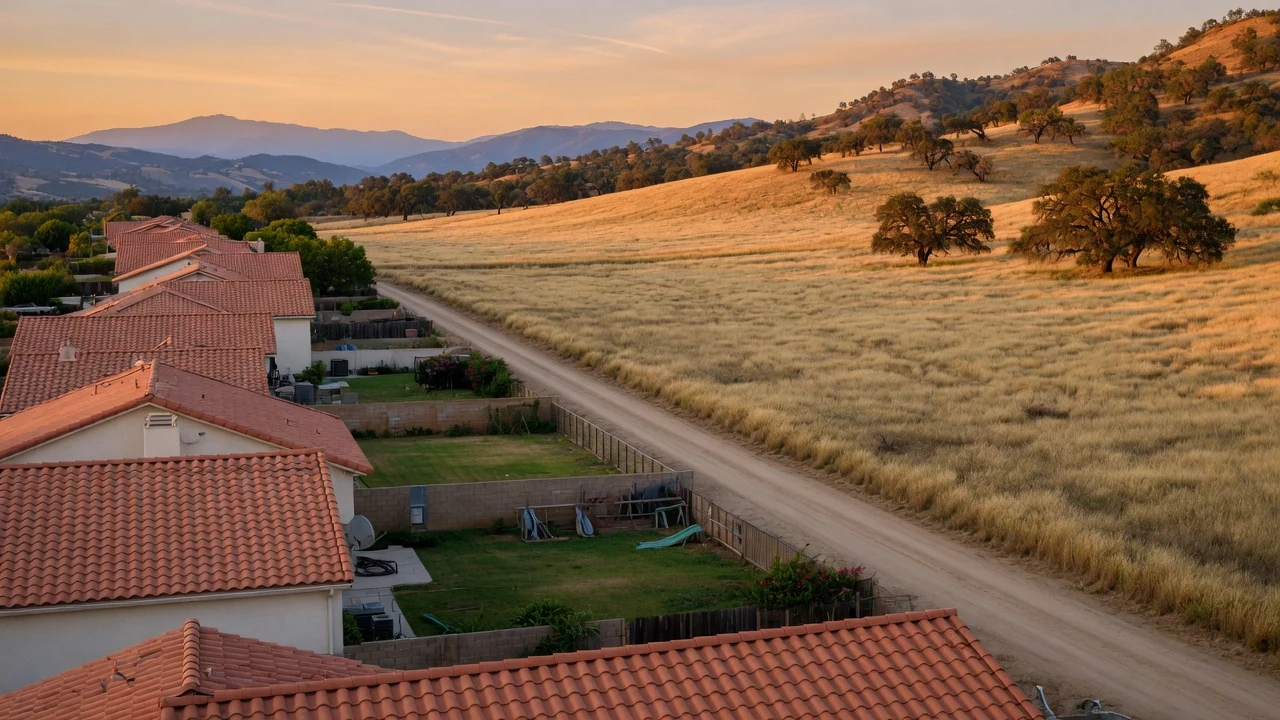
The property has to sit in an area USDA still classifies as rural. The developed centers of Temecula, Murrieta, and Menifee do not qualify, because those three cities form one continuous census urban area of 528,991 people and the federal statute excludes anything attached to one. Push ten to thirty minutes out and the answer starts changing. Because the boundary follows built-up areas rather than city limits, it can change from one house to the next on the same road.
The short version
- The geographic catch. The property has to sit in an area the USDA classifies as rural. The developed centers of Temecula, Murrieta, and Menifee are out, while nearby communities like Sage, Anza, Winchester, and Aguanga qualify. The boundary follows built-up areas rather than city limits, so eligibility can change from one house to the next on the same road.
- Income limits. The program is designed for moderate-income households. Your total household income, counting everyone living there and not just the borrowers, cannot exceed 115% of the area median income for Riverside County.
- Property standards. The home has to be a primary residence, used mainly for living rather than business, and sound enough to meet HUD safety and condition standards.
- Lower costs than FHA. Zero down does not mean zero cost, but USDA usually undercuts the common alternative. It charges a 1% upfront fee, which can be added to the loan, plus a 0.35% annual fee. Both sit below FHA's standard fees.
- Only USDA's map and an approved lender can answer for your address. Nothing on this page is a determination.
Start with the parcel, not the city
The statutory definition of a rural area sits in Section 520 of the Housing Act of 1949. Before it gets anywhere near population counts, it applies one filter: the place cannot be part of or associated with an urban area. Population tiers only matter for places that clear that first hurdle. Locally, that ordering is the whole game, because the Census Bureau's Temecula-Murrieta-Menifee urban area swallows all three cities and the developed corridor stitching them together.
This is why the "does my city qualify" framing fails. USDA's map does not care that Wildomar and Winchester are both in Riverside County, or that French Valley shares a high school attendance area with land that qualifies. The boundary follows where houses stop being densely packed. Drive north on Winchester Road and the answer flips somewhere out past the tract edge, not at a sign.
Here is how the local geography stacks up against the statute's thresholds. Treat this as an explanation of the rules, not a list of verdicts.
| Community | 2020 population | The test it runs into |
|---|---|---|
| Murrieta (city) | 110,949 | Inside the Temecula-Murrieta-Menifee urban area |
| Temecula (city) | 110,003 | Inside the same urban area |
| Menifee (city, including Sun City and Quail Valley) | 102,527 | Inside the same urban area |
| Hemet (city) | 89,833 | Far above every population tier in the statute |
| Wildomar (city) | 36,875 | Above the 35,000 ceiling on the grandfather clause |
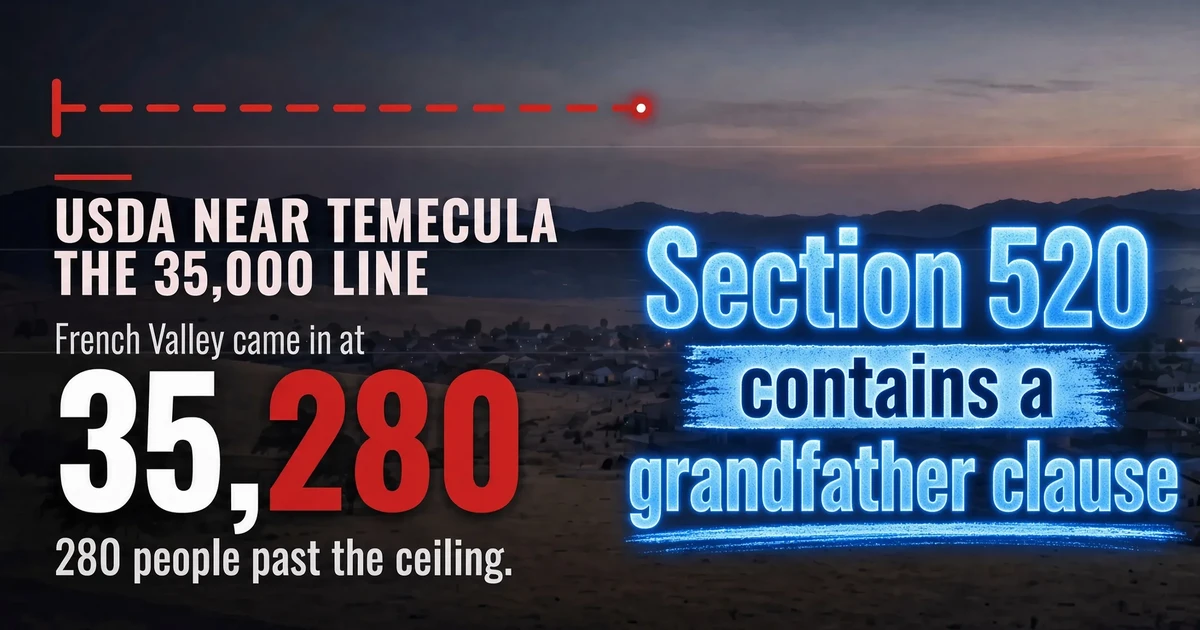
| French Valley (CDP) | 35,280 | 280 people above that same 35,000 ceiling |
| Sage (CDP) | 3,370 | Under 10,000 and rural in character |
| Anza (CDP) | 3,075 | Under 10,000 and rural in character |
| Winchester (CDP) | 3,068 | Under 10,000 and rural in character |
| Aguanga (CDP) | 989 | Under the 2,500 threshold outright |
French Valley is the one that makes people wince. It reported 35,280 residents in 2020, which puts it 280 people past the grandfather clause's ceiling. That is a rounding error in a county that adds subdivisions faster than it adds stoplights, and it is the tidiest illustration available of why you check the map instead of trusting a city name.
What this table is not
Population is the mechanism, not the verdict. USDA draws its ineligible zones as mapped boundaries around built-up areas, and those boundaries cut through communities rather than politely stopping at their edges. A parcel in a nominally ineligible city can sit outside the drawn zone, and a parcel in a small CDP can sit inside one. The USDA property eligibility site takes a street address and returns the actual answer. Use it before you fall in love with a listing.
Why the map did not move the way everyone expected
Every ten years, a rumor goes around that the new census wiped out USDA eligibility across Southern California. The 2020 cycle was no exception, and the boundaries that took effect on October 1, 2023 did move in places.
What the rumor misses is the safety valve Congress wrote into the statute, which is the reason small inland communities kept their standing through a decade of regional growth.
Section 520 contains a grandfather clause. An area classified as rural before October 1, 1990, and knocked out of that classification by data from the 1990, 2000, 2010, or 2020 census, keeps its rural status until the 2030 census arrives, provided it has between 10,000 and 35,000 residents, remains rural in character, and shows a serious lack of mortgage credit for lower and moderate income families. Areas deemed rural at any point between January 1, 2000 and December 31, 2020 get the same protection.
Two things follow. First, growth alone does not evict a community from the program, which is why the map is stickier than headlines suggest. Second, the protection has a hard ceiling of 35,000, and once a place crosses it the clause stops helping. Wildomar at 36,875 and French Valley at 35,280 are both on the far side of that line. Temecula, Murrieta, Menifee, and Hemet are not close to the conversation, and have not been for a long time. Their ineligibility is not news from 2023. It is the arithmetic of being a large city attached to a larger urban area.
The four doors into "rural," as the statute writes them
| Door | Requirement |
|---|---|
| Baseline filter | Open country, or a place not part of or associated with an urban area. Everything below assumes this is satisfied. |
| Tier 1 | Population not in excess of 2,500. |
| Tier 2 | Population above 2,500 but not above 10,000, if the place is rural in character. |
| Tier 3 | Population above 10,000 but not above 20,000, if the place is outside a metropolitan statistical area and has a serious lack of mortgage credit for lower and moderate income families. |
| Grandfather clause | Previously classified rural, reclassified by a census from 1990 onward, population between 10,000 and 35,000, still rural in character, still short on mortgage credit. Holds until the 2030 census. |
The next structural redraw arrives with the 2030 count, which means the map you check today is likely the map you will be working with for the rest of this decade. That is unusually good news for anyone planning a purchase two or three years out.
The income test is not the number you think
USDA caps household income at 115% of the area median for the county and household size. Two details trip up almost everyone who reads that sentence and reaches for a pay stub.
The first is that the program counts the income of the entire household, not just the people on the loan. An adult child with a job, a parent living in the back bedroom with Social Security, a roommate on the lease: their income enters the calculation even though their name never touches the note. Households routinely fail the test because they underestimated who counts.
The second is that the number being tested is adjusted annual income, not gross. USDA runs a worksheet that subtracts specific allowances before comparing anything to the limit, and those deductions are where borderline files get rescued. A household that looks a few thousand dollars over on paper can land comfortably under once childcare and dependents are accounted for.
| Allowance | How it works |
|---|---|
| Dependent deduction | $480 per qualifying dependent, covering household members 17 or younger, full-time students, and people with a disability. |
| Childcare expenses | Documented, unreimbursed care costs for children 12 and under, where the care enables someone to work or attend school. |
| Elderly or disabled household | $400 per household where the applicant or co-applicant is 62 or older, or has a disability. |
| Medical expenses | For elderly or disabled households, unreimbursed medical costs above 3% of annual income. |
Riverside County limits are published by household size in two bands, one for households of one to four people and a higher one for households of five to eight. The dollar figures move most years, so this article deliberately does not print them. Pull the current numbers from USDA's income eligibility materials or ask a lender to run the worksheet, because a stale limit copied off a blog is worse than no limit at all.
How the adjusted income worksheet actually runs
- Add up annual income for every adult member of the household, whether or not they are a borrower. This includes wages, self-employment, Social Security, pensions, and recurring support payments.
- Subtract the dependent allowance for each qualifying household member.
- Subtract documented childcare costs for children 12 and under.
- Subtract the elderly or disabled household allowance if it applies.
- Subtract qualifying unreimbursed medical expenses above the 3% floor for elderly or disabled households.
- Compare the result against the published limit for your county and household size.
Repayment ability is a separate calculation from eligibility. A household can pass the income cap and still fall short on debt-to-income, or clear debt-to-income comfortably while sitting a thousand dollars over the cap.
What zero down actually costs
The absence of a down payment is not the absence of a cost. USDA charges an upfront guarantee fee and an ongoing annual fee, and the regulation authorizes the agency to go considerably higher than it currently does. Under 7 CFR 3555.107, the upfront fee may not exceed 3.5% and the annual fee may not exceed 0.5% of the average scheduled unpaid principal balance. The published figures have sat well below both ceilings for years.
"Borrowers pay upfront fees and annual guarantee fees, currently set at 1% and 0.35%, respectively."
Katie Jones, Analyst in Housing Policy, and Maggie McCarty, Specialist in Housing Policy, Congressional Research Service, in USDA Rural Housing Programs: An Overview (R47044)
Those two percentages are what make USDA competitive against the obvious alternative. FHA asks 1.75% upfront and, for most 30-year loans originated above 95% loan-to-value, 0.55% annually. On a $500,000 purchase in the eligible ring, the upfront gap alone is meaningful: 1% of $500,000 is $5,000 against FHA's $8,443 on a $482,500 base loan after a 3.5% down payment. The annual side compounds the difference, running roughly $146 a month in year one on the USDA file against roughly $221 on the FHA one.
| USDA Guaranteed | FHA | Conventional, 5% down | |
|---|---|---|---|
| Minimum down payment | None | 3.5% | 5% |
| Upfront fee | 1% of the loan, financeable | 1.75% of the base loan, financeable | None |
| Annual fee or insurance | 0.35% of the balance | 0.55% for most 30-year, high-LTV loans | Private mortgage insurance, priced by credit and loan-to-value |
| Does the annual charge end? | Life of the loan unless refinanced | Life of the loan in most high-LTV cases | Yes, terminates as equity builds |
| Geographic restriction | Eligible rural areas only | None | None |
| Household income cap | 115% of area median | None | None (some programs excepted) |
The last two rows in that table are the real trade. USDA prices better than FHA on both fees, and it asks for nothing down, which in a market where the down payment is the actual barrier is close to decisive. In exchange it restricts where you can buy and how much you can earn. Conventional financing charges more up front in cash but eventually stops charging for insurance altogether, which matters if you plan to stay put for fifteen years. Neither answer is universally right, and the honest comparison depends on how long you intend to own the place. Our appraisal and market value guide covers the other side of that math, the loan-to-value ratio that decides how big the loan can be in the first place.
Stack it with assistance, or replace it
If the parcel fails the map, the zero-down goal does not have to die with it. California down payment assistance programs work on addresses USDA will not touch, and the GSFA and Platinum comparison walks through the two most common local options. Veterans have the other true zero-down path through VA financing, which carries no geographic restriction and no income cap. Everyone else usually lands on FHA with a down payment assistance layer on top.
The house has to qualify too
Passing the map and the income test still leaves the property itself. USDA requires that a financed home be predominantly residential in use, character, and design, and that phrase does more work than it looks like it does on parcels out past the tract line.
Around Anza, Sage, and Aguanga, the inventory that qualifies geographically is often the inventory carrying a barn, a tack shed, a well, and four acres of dry pasture.
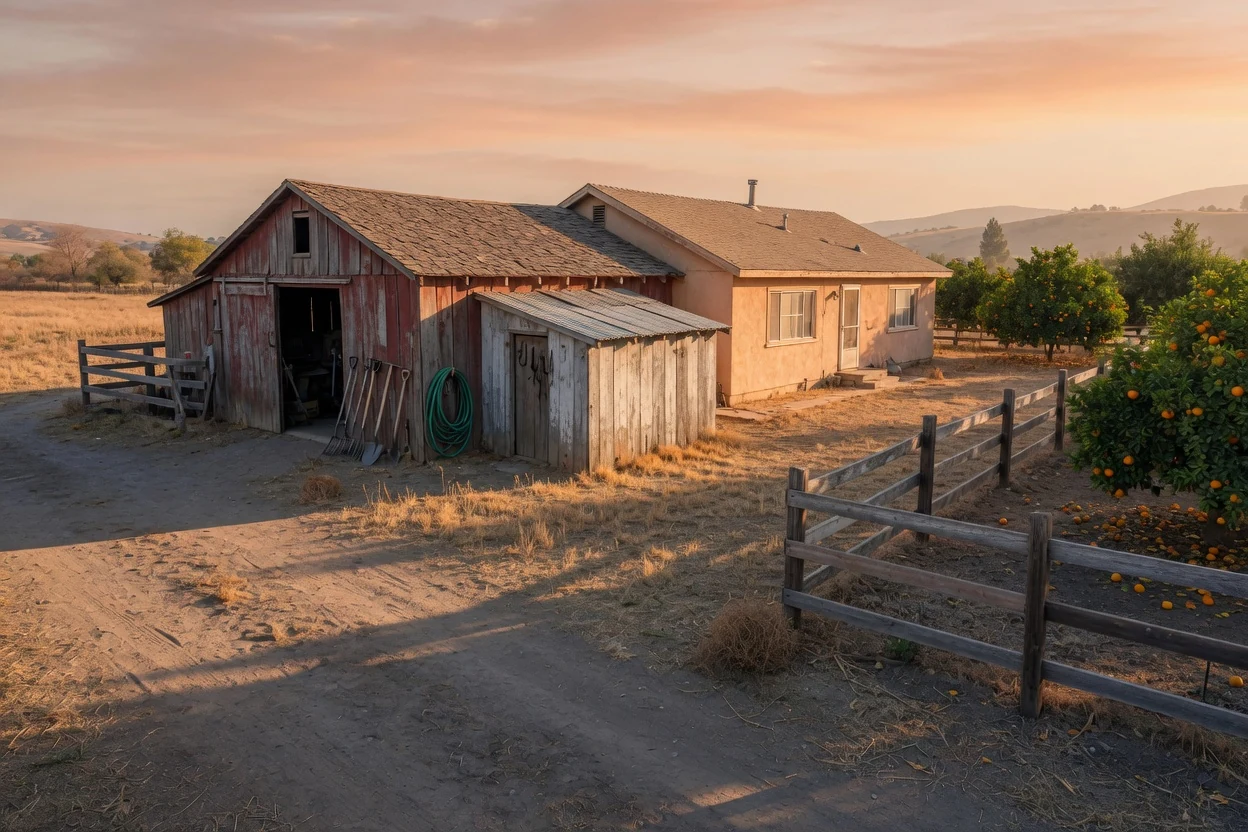
Outbuildings and acreage are not automatic disqualifiers. What draws scrutiny is a parcel where the agricultural or commercial use starts to outweigh the residential one. A barn used for personal storage reads differently than a barn supporting a working operation, and USDA permits only minimal income-producing land, verified through a legal agreement, with any resulting income counted in household income while being excluded from debt-to-income calculations.
Condition matters as much as character. An existing dwelling must be inspected against the standards in HUD Handbook 4150.2 and HUD Handbook 4905.1, the same yardsticks FHA appraisers work from. The site itself has to satisfy state and local development standards, meet community norms for water and wastewater, and have street access and maintenance adequate to keep the home marketable. On rural Riverside County parcels, that last cluster is where files stall: a shared private road with no maintenance agreement, a well without a recent potability test, or a septic system nobody has looked at since the Clinton administration.
What the appraiser is checking on a rural parcel
- Residential dominance. Is the dwelling the primary use, with outbuildings clearly secondary and non-commercial?
- Water. On a private well, expect potability and yield documentation. Shared wells need a written agreement.
- Wastewater. Septic condition and capacity relative to bedroom count.
- Access. All-weather road access. Private roads generally need a recorded maintenance agreement.
- Safety and soundness. Roof life, electrical, heating, structural condition, and anything the HUD handbooks flag as a health or safety issue.
- Marketability. Whether the property could be resold in a reasonable period, which is where unusual parcels get their hardest look.
If you are shopping the rural ring specifically, it pays to research the parcel before you write an offer rather than after the appraisal lands. Our land investigation guide covers pulling the parcel record, checking access and easements, and spotting the utility problems that surface late. The same homework that protects a land purchase protects a USDA one, and for the same reason: out there, the dirt has opinions.
Who actually funds USDA loans around here
USDA does not lend the money on a guaranteed loan. Approved lenders do, and USDA insures a portion against loss. That structure has a practical consequence buyers discover the hard way: being a mortgage lender does not mean being a USDA lender, and being a USDA lender does not mean being good at it.
Local volume is genuinely thin, because most of the population here lives inside the ineligible zone. A loan officer in Temecula might close a few hundred conventional and FHA files for every USDA file that crosses the desk. Thin volume shows up as slower turn times, more back-and-forth on the property questions above, and the occasional flat "we do not do those." None of that is malice. It is the ordinary consequence of a program that applies to a minority of local addresses.
What you want is someone who has closed a USDA file in inland Riverside County recently and can talk fluently about wells, private roads, and the map's edge cases without looking anything up. Our USDA no money down loan directory lists the lenders active in this program locally, and the free officer match exists to route the question to someone who has actually done it rather than someone willing to try.
Already own with USDA money?
This article is about getting in. Getting out is a different set of rules, and Section 502 Direct loans in particular carry a subsidy recapture obligation that can surprise sellers at closing. Our sister site covers that side in detail: USDA Rural Development eligibility and what the programs cost you when you sell.
Frequently Asked Questions
Is Temecula eligible for a USDA loan?
The developed part of the city is not, and the reason is structural rather than recent. Temecula sits inside the Temecula-Murrieta-Menifee urban area, which counted 528,991 residents in 2020, and the statute excludes places that are part of or associated with an urban area. Parcels on the outer fringe are worth checking individually on USDA's map, because the drawn boundary follows development density rather than the city limit.
What is the USDA income limit for Riverside County?
The cap is 115% of the area median income, published separately for households of one to four people and households of five to eight. The dollar figures are revised most years, so check USDA's current income eligibility materials rather than a cached number. Remember that the test applies to adjusted annual income for the whole household, after allowances for dependents, childcare, and certain elderly or disabled household expenses.
How do I check whether a specific address is USDA eligible?
Enter the street address on the USDA property eligibility site. It returns a determination for that address against the current map. Do this before you tour, not after you offer, and repeat it for every property, since eligibility can change within a single neighborhood.
Can I buy a property with a barn or several acres using a USDA loan?
Often yes. Acreage and outbuildings are not automatic disqualifiers, but the property must remain predominantly residential in use, character, and design. Only minimal income-producing land is permitted, and it needs a legal agreement. Working agricultural operations, commercial outbuildings, or parcels where the land clearly outweighs the house will draw scrutiny and may not qualify.
Does the USDA annual fee ever go away?
Not on its own. The 0.35% annual fee is charged on the average scheduled unpaid principal balance for the life of the loan, and it ends only if you refinance out of the program. Conventional private mortgage insurance behaves differently and terminates as equity builds, which is the main argument for a low-down conventional loan if you plan to hold the property for a long time.
Is a USDA loan better than FHA near Temecula?
On price, USDA wins on both fees, 1% upfront against FHA's 1.75% and 0.35% annually against FHA's 0.55% for most high-LTV 30-year loans, and it requires no down payment at all. The catch is that USDA works on a minority of local addresses and imposes a household income cap, while FHA works anywhere with no income limit. For most buyers looking inside the cities, FHA plus down payment assistance is the realistic path.
Key takeaways
- Check the address, not the city. The map follows the built-up edge, and neighbors genuinely do split.
- Urban area attachment, not the 2020 Census, is why Temecula and Murrieta are out. That has been true for a long time.
- The grandfather clause protects small inland communities until the 2030 census, but it stops at 35,000 residents. French Valley cleared that ceiling by 280 people.
- Income is tested as adjusted household income against 115% of the county median. The deductions are worth running before you assume you are over.
- Zero down costs 1% upfront and 0.35% a year, and the annual piece does not fall off by itself.
- Out in the eligible ring, the well, the septic, and the private road decide as many files as the credit report does.
USDA financing is a narrow door in this market, and the honest framing is that most people reading this will buy inside the ineligible zone and use something else. But for the buyer willing to trade fifteen minutes of commute for a program that asks nothing down and prices below FHA, the ring around this valley is one of the few places in Southern California where that trade is still available. Work through the 2026 Temecula homes for sale buyer's guide for the wider picture on pricing, neighborhoods, and the other line items that shape what a house here actually costs, then bring the specific address to someone who can check it against the map.
Sources: 42 U.S.C. 1490, Section 520 of the Housing Act of 1949 (Cornell LII), Congressional Research Service, USDA Rural Housing Programs: An Overview (R47044), 7 CFR 3555.107, guarantee and annual fee authority, USDA Property Eligibility Site, USDA Rural Development, adjusted annual income notes, USDA HB-1-3555 Chapter 12, Property and Appraisal Requirements, U.S. Census Bureau QuickFacts, U.S. Census Bureau, 2020 Census Urban and Rural Fact Sheet
Related deep-dives in this cluster
- Mello-Roos in Temecula, Explained. Decode the line item that quietly doubles your tax bill.
- Temecula HOA Fees: No-HOA vs HOA. Monthly dues by neighborhood, plus the 2026 master-insurance squeeze.
- Appraisal vs Market Value. How Temecula lenders decide what your home is worth, and what to do if the number lands low.
- Power Outage Loans in Temecula. Finance generators, batteries, and PSPS-proofing without draining savings.
- Wine Country Property Financing. The three loan paths for vineyards, estates, and wineries.
- Doffo vs. Miramonte. Pick the right Temecula tasting stop before you tour the neighborhood.
- Back to the hub: the 2026 Temecula Homes for Sale Buyer's Guide.