What Is Mello-Roos? A Plain-English Guide for Temecula Buyers
Part of the 2026 Temecula Homes for Sale Buyer's Guide. Start there for the wide view, then come back here for the close-up.
Open any Temecula listing on Zillow, scroll to the property tax estimate, and you will see something reassuring: an annual tax right around 1% to 1.2% of purchase price, perfectly California normal. Then the title company sends over a preliminary tax bill and a line item you have never heard of quietly doubles the number. Welcome to the Mello-Roos tax in Temecula, the single biggest sticker-shock moment for buyers relocating from San Diego, Orange County, or out of state.
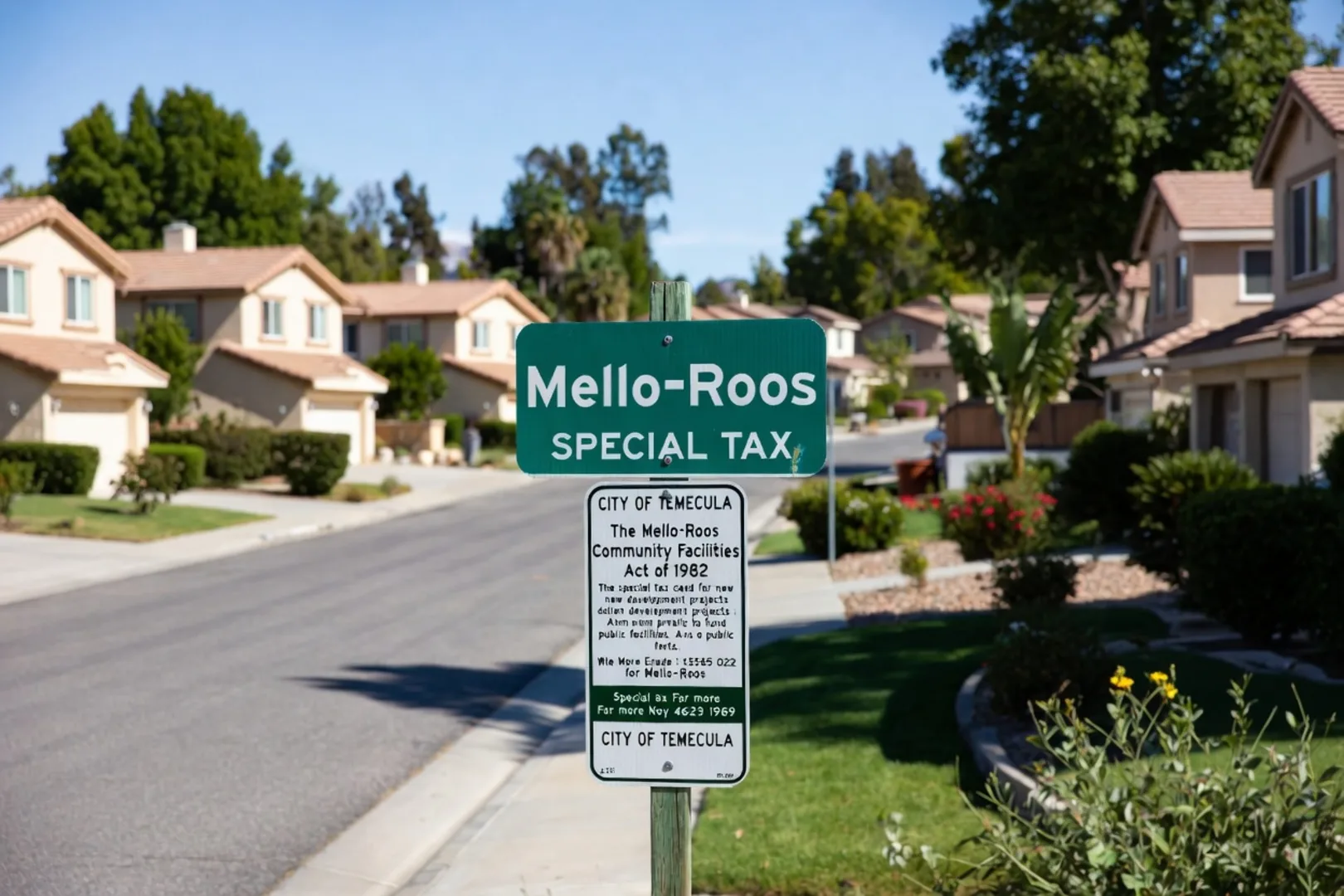
Add the Community Facilities District (CFD) assessment to the base property tax and your effective rate can jump from 1.1% to 1.9% or higher. On a $775,000 Temecula home, that is the difference between roughly $8,500 and $14,700 a year. Good news: Mello-Roos is not a gotcha. It is public record, predictable, and (with the right neighborhood list) completely avoidable. This guide breaks down what Mello-Roos actually is, why Temecula has so much of it, what you will pay in each popular community, how long the bonds last, and how the assessment affects the mortgage you qualify for.
TL;DR
- Mello-Roos is a special California property tax that funds infrastructure in new-growth communities. On a Temecula tax bill it appears as a Community Facilities District (CFD) line item.
- Most Temecula subdivisions built after 1990 sit inside one or more CFDs. Annual assessments typically run $1,000 to $3,700 per year, on top of base property tax.
- Mello-Roos expires when the underlying bonds are paid off, usually 20 to 40 years after the district was formed. Some service-funding CFDs never expire.
- Lenders include Mello-Roos in your DTI calculation. A $3,600 annual assessment can reduce your maximum loan amount by $50,000 to $60,000.
- Older Temecula neighborhoods (Old Town, Meadowview, Los Ranchitos, The Villages, parts of Rancho Highlands) have little or no Mello-Roos. Newer builds almost always do.
What Is Mello-Roos? The CFD Acronym, Explained
Mello-Roos is a special tax that California cities, counties, and school districts use to fund public infrastructure in newly developed areas. The formal name is a Community Facilities District, abbreviated CFD. When you see "CFD" on a Riverside County tax bill, that is Mello-Roos wearing its government-issued nametag.
Definition: Mello-Roos / CFD
A Community Facilities District is a geographic area created by a local agency to sell bonds that pay for roads, schools, parks, fire stations, sewer lines, or ongoing services. Homeowners inside the district pay a special annual tax (the Mello-Roos assessment) until those bonds are repaid. The tax runs with the land, not the owner, so every future buyer inherits it.
The name honors the two legislators who authored the bill, Senator Henry Mello and Assemblyman Mike Roos, who passed the Mello-Roos Community Facilities Act in 1982, four years after California voters approved Proposition 13. Prop 13 capped base property tax at 1% of assessed value, which was a windfall for existing homeowners and a crisis for any city trying to fund schools and fire stations for tens of thousands of incoming residents. Mello-Roos was the workaround.
The mechanics are simple. A city or school district forms a CFD around a new tract and issues bonds to pay for the infrastructure. Every lot inside the district gets a special tax attached to its parcel number, paid on top of regular property tax, twice a year, until the bonds are retired.
Why Temecula Has So Much Mello-Roos
Temecula is one of the youngest cities in California. It was unincorporated cattle country and vineyard until residents voted to form the City of Temecula in 1989, seven years after the Mello-Roos Act became law. The city grew from roughly 27,000 people in 1990 to more than 110,000 today, and Prop 13 made it impossible to raise the ad valorem rate to fund that growth. Mello-Roos paid for the new schools in Redhawk, the fire stations in Harveston, the arterial roads through Wolf Creek, and the sewer capacity east of Butterfield Stage Road. Nearly every subdivision you will tour in 2026 sits inside at least one CFD as a result.
Temecula Valley Unified School District alone administers two district-wide CFDs (commonly referenced as CFD 88-12 and CFD 2002-2) that funded school construction across the valley. Layered on top are city-level districts tied to individual subdivisions, which is why many Temecula homes pay into two or even three Mello-Roos assessments at once and why the total can climb into the $3,000+ range in newer communities.
How Mello-Roos Shows Up on Your Temecula Tax Bill
The Riverside County annual property tax bill splits into three parts. Understanding the layout is the fastest way to see exactly what a home costs to own.
| Line Item | How It Is Calculated | Typical on $775,000 Home |
|---|---|---|
| Base 1% ad valorem (Prop 13) | 1% of assessed value | $7,750 |
| Voter-approved bonds | ~0.05% to 0.15% of assessed value | $400 to $1,160 |
| Special assessments / Mello-Roos | Flat dollar amount per parcel | $0 to $3,700+ |
The first two lines scale with your purchase price. The third does not. Mello-Roos is a flat dollar amount assigned to the parcel when the CFD was formed, often adjusted annually by a capped escalator (typically 2% a year). Two identical floor plans on the same cul-de-sac can pay very different Mello-Roos totals if one falls inside an older, smaller CFD and the other sits in a newer one funding a bigger package of infrastructure.
Pro Tip: Run the Effective Tax Rate Before You Write an Offer
Add the Mello-Roos to the base tax, divide by purchase price, and you get the effective tax rate. A home priced at $775,000 with a $3,200 annual Mello-Roos has an effective rate of about 1.51%, not the 1% the listing portal shows. Compare that to a similar home with zero Mello-Roos at 1.1% and suddenly the "cheaper" house is not cheaper at all.
Typical Mello-Roos by Temecula Neighborhood
Here is what Temecula buyers are actually paying in the communities most search for. These ranges reflect current MLS disclosures and county records. Any specific property can sit at the high or low end of its community range depending on lot size, year built, and which layered CFDs apply to that parcel.
| Neighborhood | Era Built | Typical Mello-Roos (Annual) | HOA Present? |
|---|---|---|---|
| Paloma del Sol | 1990s | Under $1,000 | Yes, moderate |
| Vail Ranch | Late 1990s | $500 to $1,200 | Low or none |
| Redhawk | Late 1990s to 2000s | $1,200 to $2,400 | Varies by tract |
| Harveston | Mid-2000s | $1,700 to $2,400 | Yes, amenity-rich |
| Roripaugh Ranch | 2000s to 2010s | ~$1,900 | Yes |
| Wolf Creek | Mid-2000s | $2,000 to $3,200 | Yes |
| Morgan Hill | 2000s to 2010s | $2,400 to $3,500 | Yes, premium |
| Sommers Bend | 2020s | $3,300 to $3,700 | Yes, premium |
| Wine Country (east of Butterfield) | Varies widely | $0 to $1,500 (rural) | Usually none |
Two patterns jump out. Newer communities carry higher Mello-Roos because they funded more infrastructure with bigger bonds. And the prestige amenity communities (lake access at Harveston, trail systems at Morgan Hill, the resort-style facilities at Sommers Bend) charge for those amenities through both the HOA and the CFD, stacked.
Temecula Neighborhoods With Little or No Mello-Roos
This is the question local agents get asked most often: which Temecula neighborhoods have no Mello-Roos? The answer lives almost entirely in the city's pre-2000 footprint.
- Old Town Temecula and surrounding residential: Many of the older craftsman and ranch-style homes near the historic Old Town district predate 1990 and sit outside any CFD.
- Meadowview: An established equestrian community with minimal or no Mello-Roos, larger lots, and an older housing stock.
- Los Ranchitos: Rural-residential with 1-acre-plus lots, typically no Mello-Roos, though specific properties vary.
- The Villages: No Mello-Roos and low HOA, trading newer finishes for lower carrying cost.
- Rancho Highlands (older sections): Parts of this centrally located community have low or no Mello-Roos and modest HOA dues.
- Portions of Wine Country: Rural parcels east of Butterfield Stage Road often sit outside city CFDs, though some carry school-district CFDs.
Verify Before You Fall in Love
"Neighborhood has no Mello-Roos" is a generalization. Individual parcels inside these communities can still fall inside a school-district CFD or a small overlay district. Always confirm the specific property's tax bill (not the neighborhood reputation) before writing an offer.
How Long Does Mello-Roos Last in Temecula?
Most Mello-Roos bonds are issued for 20 to 40 years. The special tax ends when the bonds are fully repaid, which in practice means somewhere between 2035 and 2060 for most Temecula CFDs issued during the big growth years of the 1990s and 2000s. The exact sunset depends on when the bonds were sold and whether they have been refinanced.
One exception matters. Some CFDs fund ongoing services (fire, park maintenance, street lighting) rather than one-time infrastructure, and those can be levied in perpetuity with no sunset. To find the specific maturity date for a property, request the CFD's Rate and Method of Apportionment document (the RMA) from the listing agent. The RMA spells out the current tax, the annual escalator, and the final year of assessment.
Mello-Roos vs HOA: They Are Not the Same
Buyers conflate these constantly, and the confusion is expensive. Here is the clean distinction.
| Feature | Mello-Roos (CFD) | HOA |
|---|---|---|
| Who collects it | Government (county, city, school district) | Private homeowners association |
| What it funds | Public infrastructure, schools, roads, fire | Private amenities, common areas, management |
| How it shows up | Line item on the property tax bill | Separate monthly or quarterly bill |
| Tax deductible? | Generally no (not ad valorem) | No |
| Does it expire? | Usually yes, when bonds are repaid | No, as long as the HOA exists |
| Enforcement for non-payment | Tax lien, can lead to foreclosure | HOA lien, can lead to foreclosure |
You can buy a Temecula home with only an HOA, only Mello-Roos, both, or neither. The newer and more amenity-rich the community, the more likely you will see both stacked, with a total carrying cost well above what a comparable home in Menifee or Murrieta might show.
How Mello-Roos Affects Your Mortgage Qualification
This is the part most buyers never think about until their lender runs the numbers. Mello-Roos is a mandatory recurring housing expense, and every major loan program includes it in your debt-to-income (DTI) ratio. That directly reduces how much home you can qualify for.
The math is ugly on purpose: a $4,000 annual Mello-Roos adds about $333 per month to the housing payment used in DTI, cutting the buyer's maximum loan amount by roughly $50,000 to $60,000 on conventional loans. On FHA loans the effect is sharper, because qualification ratios are tighter to begin with. A Temecula buyer stretching for a $750,000 FHA purchase can find the deal falling apart over a $3,000 Mello-Roos line.
"A $4,000/year Mello-Roos assessment adds roughly $333/month to the buyer's total housing cost. Lenders include this in debt-to-income calculations, which means the buyer qualifies for approximately $50,000 to $60,000 less in loan amount."
JVM Lending, Mello-Roos Tax: What It Is, How It Works, and What to Budget
Effective monthly Mello-Roos impact = Annual assessment / 12
Example: $3,200 annual Mello-Roos / 12 = $267 per month added to PITI. At current rates, that is the equivalent of financing roughly $45,000 less in loan principal.
Expert Tip: Get Pre-Approved on the Actual Parcel, Not a Generic Estimate
Most lenders pre-approve using a default property tax assumption of 1.2% of purchase price. That number is wrong by a mile in Temecula. When you identify a specific property, ask your lender to re-run the pre-approval using the exact tax bill (base + bonds + Mello-Roos) for that parcel. It is the only way to know if the payment you were quoted is the payment you will actually make. Explore your home loan options with a lender who knows Riverside County and can run the math on Mello-Roos before you write the offer, not after.
How to Look Up the Exact Mello-Roos on Any Temecula Listing
Do not trust the MLS property tax estimate or Zillow. Get the real number from the source in under five minutes.
- Pull the Assessor Parcel Number (APN) from the listing (a 9- or 10-digit number formatted like 962-123-456).
- Visit the Riverside County Treasurer-Tax Collector online portal and enter the APN to see the current year's tax bill.
- Scroll to the "Special Assessments" or "Direct Assessments" section. Each CFD line is listed separately with its own dollar amount. Add them together for your total annual Mello-Roos.
- Ask the listing agent for the RMA for each CFD. It shows the annual escalator and the bond maturity year.
For new construction, the builder is legally required to provide a Mello-Roos disclosure before the purchase contract. Underline the total annual amount, the escalator cap, and the maturity date before you sign.
Frequently Asked Questions
How much is Mello-Roos in Temecula on average?
Most Temecula homes built after 1990 pay between $1,000 and $3,700 per year in Mello-Roos, with newer premium communities like Sommers Bend at the top end and established 1990s tracts like Paloma del Sol at the low end. Older homes built before 1990 or in Wine Country often pay nothing. Always check the specific parcel's tax bill rather than relying on a neighborhood average.
How long does Mello-Roos last in Temecula?
Most Temecula Mello-Roos bonds were issued for 20 to 40 years, meaning current assessments typically expire between 2035 and 2060 depending on when the CFD was formed. The exact sunset date for a specific property is spelled out in the CFD's Rate and Method of Apportionment document. Service-only CFDs that fund ongoing operations rather than bonds can continue indefinitely.
Which Temecula neighborhoods have no Mello-Roos?
Older, pre-2000 Temecula communities are your best bet for little or no Mello-Roos. Look at Old Town Temecula, Meadowview, Los Ranchitos, The Villages, and older sections of Rancho Highlands. Some rural Wine Country parcels east of Butterfield Stage Road also sit outside city CFDs, although a school-district CFD may still apply. Always verify the exact parcel before assuming.
Is Mello-Roos tax deductible?
Generally no. The IRS only allows deduction of ad valorem property taxes (the Prop 13 base 1%). Mello-Roos is a special assessment based on a flat parcel amount, not on the value of the property, so it does not meet the ad valorem test and is typically not deductible on your federal return. Consult a CPA for your specific situation.
Can I pay off Mello-Roos early?
Some Temecula CFDs allow prepayment, meaning you can pay a lump sum to buy out your share of the bonds and remove the lien. The prepayment amount usually runs 10 to 15 times the current annual assessment, which is rarely worth it unless you plan to hold the home long term. Ask the CFD administrator for the current prepayment calculation before making the call.
Key Takeaways
- Mello-Roos is a real line item, not a fee: it is a special tax backed by a lien on your property, enforced by the county.
- Temecula has it because Temecula is new: virtually every post-1990 subdivision sits in at least one CFD.
- Ranges matter more than averages: $1,000 a year in Paloma del Sol and $3,700 a year in Sommers Bend are both "Temecula Mello-Roos."
- It affects your loan, not just your monthly payment: lenders include it in DTI, and that can shrink your maximum loan amount by tens of thousands.
- Verify the exact parcel: never trust a portal estimate or a neighborhood rumor, always pull the Riverside County tax bill for the specific APN.
Put This in Context With the Rest of Your Temecula Buyer Homework
Mello-Roos is one piece of a larger Temecula buying decision. Price tiers, school boundaries, HOA health, commute to San Diego or Orange County, and current market conditions all interact with the CFD question. For the full picture, work through our Temecula homes for sale buyer's market guide, which covers 2026 market data, neighborhood comparisons, closing costs, and financing strategy. When you are ready to run the real numbers on a specific property (base tax, bonds, Mello-Roos, insurance, HOA, the whole monthly), get pre-approved with a lender who prices loans against the actual parcel, not a default estimate. That one step is the difference between a Temecula offer that closes and one that falls apart at underwriting. If you are also weighing Temecula against neighboring Murrieta, our Murrieta vs Temecula buyer comparison guide covers how Mello-Roos and base property tax differ between (and within) the two cities.
Sources: Greenleaf Real Estate Temecula & Murrieta Mello-Roos Guide, JVM Lending Mello-Roos Explained, City of Temecula Debt Management, TVUSD Community Facilities Districts, LegalZoom Mello-Roos Overview
Mello-Roos is one layer of a bigger picture. For the full walk-through of parcel identity, zoning, hazards, utilities, and financing, see our Temecula land investigation guide.
Related deep-dives in this cluster
- Power Outage Loans in Temecula. Finance generators, batteries, and PSPS-proofing without draining savings.
- Wine Country Property Financing. The three loan paths for vineyards, estates, and wineries.
- Doffo vs. Miramonte. Pick the right Temecula tasting stop before you tour the neighborhood.
- Temecula HOA Fees: No-HOA vs HOA. Monthly dues by neighborhood, plus the 2026 master-insurance squeeze.
- Appraisal vs Market Value. How Temecula lenders decide what your home is worth, and what to do if the number lands low.
- USDA Loan Eligibility Near Temecula. Which addresses actually qualify for zero down, and why neighbors can split.
- Back to the hub: the 2026 Temecula Homes for Sale Buyer's Guide.