Sommers Bend and Temecula HOA Fees: No-HOA vs HOA Neighborhoods
Part of the Temecula Homes for Sale: The 2026 Market Brief. Start there for the wide view, then come back here for the close-up.
Two identical four-bedroom homes sit a mile apart in Temecula. Same square footage, same builder, same school zone. One charges $34 a month in HOA dues. The other charges $330. Multiply that gap across thirty years of ownership and the choice between an HOA-heavy neighborhood and a no-HOA pocket is worth somewhere north of a hundred and ten thousand dollars. Welcome to the second-most-expensive line item Temecula buyers underestimate, after Mello-Roos.
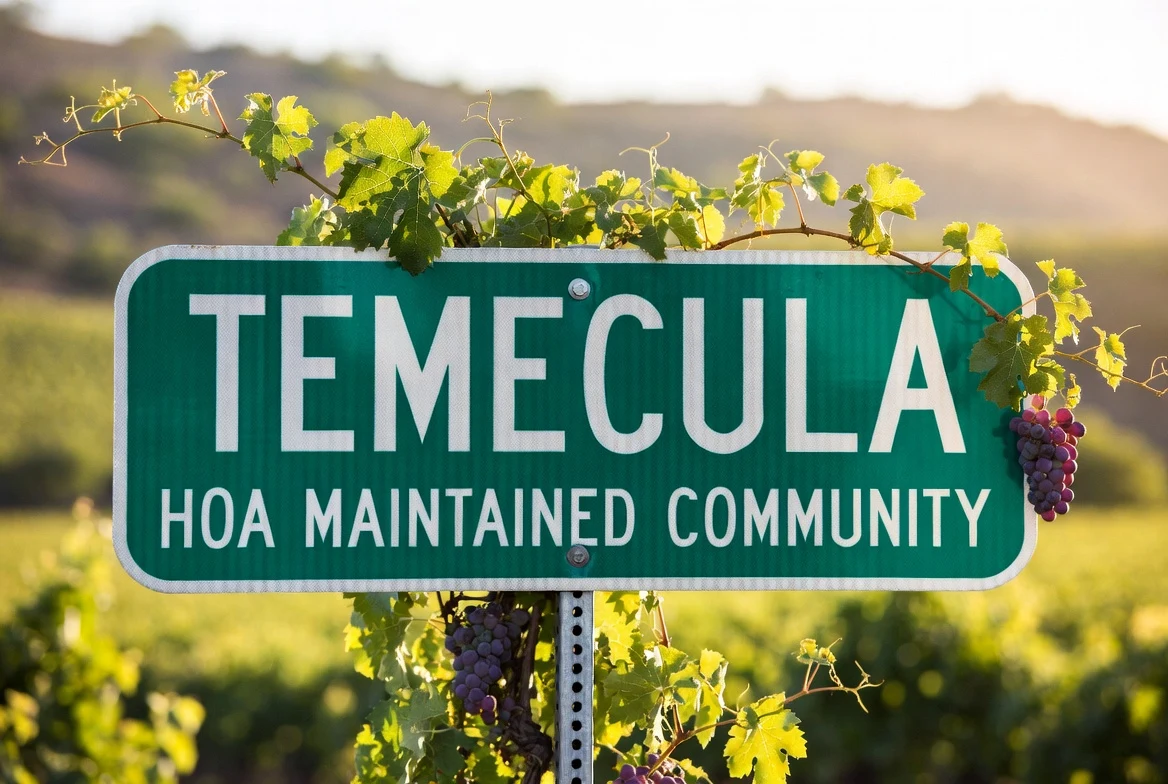
Temecula HOA fees in 2026 range from a token $34 a month in older Redhawk tracts to $330 or more in the newest premium subdivisions like Sommers Bend. The fee depends on what the association maintains (pools, gyms, lakes, gates) and what the master insurance policy now costs (a lot more than it did three years ago). Layer that on top of Mello-Roos and base property tax, and the carrying cost of a Temecula home looks very different than the Zillow estimate suggests. This guide breaks down what Temecula HOA fees actually pay for, what every popular neighborhood is charging in 2026, where to find no-HOA alternatives, and how the dues directly shrink the mortgage you can qualify for.
TL;DR
- Temecula monthly HOA fees in 2026 typically run from $34 (older Redhawk) to $330 or more (Sommers Bend, gated luxury). Most family neighborhoods land between $75 and $200.
- Some Temecula HOAs charge two layered fees: a master association covering district-wide amenities plus a sub-HOA for the specific tract.
- True no-HOA Temecula neighborhoods exist in older pockets: Los Ranchitos, parts of Old Town, Santiago Estates, and rural Wine Country parcels east of Butterfield Stage Road.
- California HOA insurance premiums are projected to rise 10% to 30% in 2026, which means dues hikes or special assessments are coming for most associations.
- Lenders include HOA dues in your DTI calculation. A $250 monthly fee can shrink your maximum conventional loan amount by roughly $40,000 to $50,000.
The 90-Second Temecula HOA Cost Snapshot
Before you fall in love with a listing photo, know the carrying cost. Five Temecula housing categories cover virtually every buyer scenario, each with its own typical HOA range. Match your target neighborhood to the row that fits and you have a working monthly budget in under a minute.
| Neighborhood Type | Typical Monthly HOA | What's Included | Common Examples |
|---|---|---|---|
| Older established (1990s) | $0 to $50 | Bare-bones, sometimes nothing | Redhawk basic, Vail Ranch, Crowne Hill |
| Mid-tier amenity | $75 to $130 | Pool, parks, basic clubhouse | Paloma del Sol, Harveston, Morgan Hill |
| Premium amenity, gated | $150 to $250 | Gym, security, larger clubhouse, sport courts | Roripaugh Ranch, The Vineyard |
| Newest luxury, resort | $230 to $350 | Wellness center, pickleball, lakes, gated | Sommers Bend, Esplanade at Sommers Bend |
| No HOA | $0 | Owner handles everything | Los Ranchitos, parts of Old Town, Santiago Estates |
Two patterns explain almost everything you need to know about Temecula HOA pricing. Newer always costs more, because newer means more amenities and a younger reserve fund still building toward target funding levels. And amenity-heavy always costs more, because pools and lakes and resort-style fitness centers are not free to operate, insure, or replace.
What Your Temecula HOA Fee Actually Buys
The number on the closing disclosure is just the entry fee. Once you understand what an HOA spends money on, the gap between $34 and $330 stops looking arbitrary and starts looking like a cost-of-amenities equation.
Definition: HOA / Homeowners Association
A homeowners association is a private nonprofit corporation that owns and maintains the common areas of a planned community (pool, clubhouse, perimeter walls, entry monuments) and enforces the recorded covenants, conditions, and restrictions (CC&Rs) that came with your property. California HOAs are governed by the Davis-Stirling Common Interest Development Act, which sets the rules every Temecula association must follow.
A Temecula HOA's annual budget breaks down across four buckets. The split looks roughly the same whether your dues are $50 or $250, but the absolute dollar amount in each bucket scales with the amenity stack and the size of the association.
| Budget Bucket | Typical Share | What It Covers |
|---|---|---|
| Operations and maintenance | 40% to 55% | Landscaping, pool service, common-area utilities, janitorial, trash for shared facilities |
| Insurance | 15% to 25% | Master property policy, general liability, directors and officers (D&O), umbrella, fidelity bond |
| Reserves | 15% to 25% | Future replacement of roofs, asphalt, pool plaster, equipment (per the reserve study) |
| Management and admin | 10% to 15% | Property management contract, accounting, legal, audit, election costs |
The insurance bucket is the one quietly shifting in 2026. Three years ago it was 12% of an average California HOA budget. Today most boards are setting it closer to 22%, and a few coastal and wildfire-exposed associations have pushed it past 30%. That shift is why Temecula buyers will hear about dues increases over the next two years even in well-run neighborhoods that have not raised fees in a decade.
Temecula HOA Fees by Neighborhood (2026 Ranges)
Here is what Temecula buyers are actually paying right now, pulled from current MLS disclosures and association management filings. Specific tracts within a master-planned community can sit at the high or low end of the range based on which sub-HOA the parcel falls inside, so always confirm with the listing's HOA disclosure packet.
| Community | Typical Monthly HOA | Headline Amenity | Mello-Roos Likely? |
|---|---|---|---|
| Redhawk (older sections) | $34 | Common-area maintenance only | Yes, $1,200 to $2,400 a year |
| Vail Ranch | $0 to $40 | Limited or no association | Yes, $500 to $1,200 a year |
| Crowne Hill | $75 to $80 | Parks, trails, common landscaping | Yes, varies |
| Wolf Creek | $45 to $88 | Pool, gym, splash pad, trails | Yes, $2,000 to $3,200 a year |
| Harveston (Lake) | $95 plus sub-HOA | Lake, paddle boats, pool, clubhouse | Yes, $1,700 to $2,400 a year |
| Morgan Hill | $99 to $150 | Resort clubhouse, pool, spa, gym | Yes, $2,400 to $3,500 a year |
| Paloma del Sol | $99 to $130 | Multiple pools, tennis, tot lots | Yes, often under $1,000 a year |
| Meadowview | $45 (paid quarterly as $239) | Equestrian center, two pools, tennis | Usually no |
| Roripaugh Ranch | $182 | Gated, clubhouse, pool, gym | Yes, around $1,900 a year |
| The Vineyard | $200 to $350 | Gated pool, clubhouse, sport courts | Varies |
| Sommers Bend | $230 to $330 | Wellness center, pickleball, "The Barn" | Yes, $3,300 to $3,700 a year |
| Los Ranchitos | $0 | None (equestrian, 1 to 5 acre lots) | Generally no |
Notice the layered HOA pattern in Harveston and Sommers Bend. Both are master-planned communities where homeowners pay into one association covering the district-wide amenities (the lake, the wellness center, "The Barn") and a second sub-HOA covering their specific tract. Some Sommers Bend buyers report a combined dues total above $400 a month once both lines are added together, which is closer to a small condo HOA than a traditional Temecula single-family fee.
Full Temecula HOA fee lookup with amenity stack and special assessment notes (2026)
| Community | Era Built | Monthly Dues | Amenity Stack | Special Assessment History |
|---|---|---|---|---|
| Redhawk (basic tracts) | 1990s | $34 | Common-area landscaping | None recent |
| Redhawk (gated sections) | 1990s to 2000s | $50 to $100 | Gate, golf course views | Occasional |
| Vail Ranch | Late 1990s | $0 to $40 | Minimal | None typical |
| Crowne Hill | 2000s | $75 to $80 | Parks, trails | None recent |
| Wolf Creek | Mid-2000s | $45 to $88 | Pool, gym, parks, splash pad | Occasional for recreation refresh |
| Harveston (Lake) | Mid-2000s | $95 plus sub-HOA | Lake, pool, clubhouse, paddle boats | Lake dredging assessments possible |
| Morgan Hill | 2000s to 2010s | $99 to $150 | Clubhouse, pool, spa, gym | Insurance-driven hike likely 2026 |
| Paloma del Sol | 1990s to 2000s | $99 to $130 | Pools, tennis, parks | None recent |
| Meadowview | 1980s to 1990s | $45 | Equestrian, pools, tennis, clubhouse | Equestrian facility refresh |
| Roripaugh Ranch | 2000s to 2010s | $182 | Gated, clubhouse, pool, gym | Phase II completion costs |
| The Vineyard (gated) | 2000s to 2010s | $200 to $350 | Gate, pool, sport courts | Higher insurance-driven risk |
| Sommers Bend | 2020s | $230 to $330 | Wellness center, pickleball, lakes, gated | Reserve build still maturing |
| Esplanade at Sommers Bend (55+) | 2020s | $300 to $400 | Resort club, gated, age-restricted programs | Reserve build still maturing |
| Los Ranchitos | 1980s | $0 | None (equestrian, 1 to 5 acre lots) | n/a |
| Old Town (older blocks) | Pre-1990 | $0 in most cases | None | n/a |
Pro Tip: Run the Combined Carrying Cost Before You Tour
Add the monthly HOA, the monthly Mello-Roos (annual divided by 12), the base property tax (annual divided by 12), and your mortgage payment together. That number is your real PITI in Temecula. The same $775,000 home can carry $250 more or less per month depending entirely on which side of an arterial road it sits on. Getting the math right on day one prevents a write-an-offer-then-cannot-qualify scramble at underwriting.
Where to Look in Temecula If You Want No HOA
The buyers who walk away from HOA dues entirely tend to fall in one of two camps. Equestrian and rural-residential buyers who want acreage and chickens, and value-focused buyers who would rather paint their fence pink than pay a board for permission. Temecula has options for both.
- Los Ranchitos: The flagship no-HOA Temecula equestrian community. Lots run 1 to 5 acres, many already set up for horses, and there is no association at all. Carrying cost is dominated by property tax (often without Mello-Roos) and well or septic where applicable.
- Meadowview: A nominal HOA ($45 a month, paid as $239 quarterly) that buys equestrian-center access, two heated pools, tennis, basketball, and a clubhouse. Reasonable HOA fees with comparatively low taxes; technically not zero-HOA, but priced like an old-school neighborhood.
- Old Town and surrounding pre-1990 streets: Many of the older craftsman, ranch, and mid-century homes near historic Old Town predate California's planned-community boom and never joined an association.
- Santiago Estates: A Temecula luxury enclave occasionally marketed with the phrase "no HOA, low taxes." Expect larger lots, semi-custom homes, and self-managed maintenance.
- Wine Country (parcels east of Butterfield Stage Road): Most rural Wine Country acreage sits outside any HOA. Some still carry a school-district CFD, but private dues are rare. This is the no-HOA sweet spot for buyers who want vineyard frontage or a tasting-room-style estate.
- Older sections of Rancho Highlands: Pockets of this central neighborhood have low or no HOA dues. Verify lot by lot, since the boundary is not always obvious.
"No HOA" Is Almost Never Free
Skipping the HOA does not mean skipping the costs. Without an association you fund your own roof replacement, your own perimeter wall repair, your own landscaping, and (in rural neighborhoods) your own well, septic, and private-road maintenance. The smart math compares an HOA's monthly fee to what the same services would cost you to manage privately, not to zero.
Why Temecula HOA Dues Are Climbing in 2026
Two forces are squeezing California HOA budgets simultaneously: a master-insurance market that has hardened severely, and a Davis-Stirling reserve regime that does not let boards skip funding for the deferred-maintenance can-kicking that used to keep dues artificially low. Temecula is not immune. Buyers touring in 2026 should expect dues notices to arrive at almost any association by year-end.
"We're seeing a great hardening of the market right now due to global conditions. A lot of clients are experiencing premium increases, underwriting guidelines are tightening, and carriers are pulling out of the market. Claims, liability and litigation have all increased. To that end, association boards should be increasing their insurance line items by at least 10% and up to 30%, depending on their property type and if they've had losses."
Jamie George, Vice President of Insurance, FirstService Financial, as quoted in FirstService Residential California, Ask the HOA Insurance Experts
Annual HOA dues impact = (Insurance line increase) divided by (Number of homes in association)
Example: A 400-home Temecula HOA with a $90,000 insurance line takes a 25% bump. That is $22,500 in extra premium spread across 400 doors, or $56 per home per year. The board absorbs it through a $5 monthly dues increase. A smaller 80-home association in the same scenario would see a $23 monthly bump, more than four times the impact.
The squeeze is sharper for smaller communities and for any association with claims history. Wildfire-exposed properties in the eastern Temecula Valley, condo or attached-product communities, and any HOA that sits inside a brush-zone designation can land at the top of that 30% range. Standalone single-family neighborhoods on the I-15 corridor, with newer construction and no claims, often come in closer to the 10% floor.
HOA vs Mello-Roos: They Are Not the Same
This is the confusion that costs Temecula buyers the most money, because both costs feel similar (a recurring assessment outside the mortgage payment) but they are governed by very different rules. Get the categories straight and the rest of the carrying-cost math falls into place.
| Feature | HOA Dues | Mello-Roos (CFD) |
|---|---|---|
| Who collects it | Private homeowners association | Government (city, county, school district) |
| What it funds | Private amenities, common areas, master insurance | Public infrastructure, schools, roads, fire |
| How it appears | Monthly or quarterly invoice | Line item on Riverside County tax bill |
| Tax deductible? | No | Generally no (not ad valorem) |
| Does it expire? | No, while the HOA exists | Usually yes, when bonds are repaid |
| Lien for non-payment? | HOA lien, can lead to foreclosure | Tax lien, can lead to foreclosure |
| Negotiable or removable? | Only by dissolving the HOA (rare) | Sometimes prepayable in lump sum |
You can buy a Temecula home with only an HOA, only Mello-Roos, both, or neither. The newest amenity-rich communities (Sommers Bend, Morgan Hill, Roripaugh Ranch) routinely stack both, which is why a $775,000 home in those neighborhoods can carry $400 a month or more in combined HOA plus Mello-Roos before the first dollar of mortgage hits the spreadsheet. For the deep-dive on how Mello-Roos works alongside HOA dues, see our Mello-Roos in Temecula explainer.
How HOA Fees Affect Your Mortgage Qualification
Lenders treat HOA dues exactly the same way they treat property tax and insurance: a mandatory recurring housing expense that gets folded into your debt-to-income ratio. Fannie Mae, Freddie Mac, FHA, and VA all require HOA dues to be included in the qualifying payment (the PITIA, where the second "I" is insurance and the "A" is association dues). That means every additional dollar of monthly HOA is one less dollar you can carry in mortgage principal and interest.
| Monthly HOA | Reduction in Monthly Mortgage Capacity | Approximate Loan Amount Reduction |
|---|---|---|
| $50 (older Redhawk) | $50 | About $7,500 to $9,000 |
| $100 (Wolf Creek, Paloma del Sol) | $100 | About $15,000 to $18,000 |
| $200 (Roripaugh Ranch, gated) | $200 | About $30,000 to $36,000 |
| $330 (Sommers Bend top-tier) | $330 | About $50,000 to $60,000 |
| $400 (layered HOA stack) | $400 | About $60,000 to $72,000 |
The numbers above assume current 30-year conforming rates in the 6% to 6.5% range. At lower rates the borrowing-capacity hit per dollar of HOA is slightly larger; at higher rates it shrinks. Either way, the directional point holds: an extra $250 a month in HOA dues quietly removes $40,000 to $50,000 from the home you can buy.
Expert Tip: Re-Run Your Pre-Approval With the Real HOA Number
Most Temecula pre-approvals are written assuming a default $0 HOA, especially when the buyer has not yet picked a target neighborhood. The minute you fall in love with a Sommers Bend listing, ask your lender to refresh the pre-approval with the actual HOA disclosure attached to that address. Twice a month a deal in Temecula falls apart at underwriting because the buyer was qualified at the no-HOA number and offered on a $300-a-month-HOA home. Explore your home loan options with a lender who will price the loan against the actual property, not a generic estimate.
Vetting a Temecula HOA Before You Write the Offer
The dues number is just the visible tip. The real risk lives inside the disclosure packet, where reserve funding, recent special assessments, ongoing litigation, and pending capital projects either confirm or contradict the headline fee. California requires sellers to deliver this packet to buyers, but you have to read it.
- Pull the Resale Disclosure Packet (sometimes called the HOA Resale Certificate or California Civil Code section 4525 disclosure). Your agent should request it the day you go under contract.
- Check the Reserve Study for "percent funded." Above 70% is healthy. Below 30% is a flashing red light that future special assessments are likely.
- Read the past 12 months of board meeting minutes. Boards talk about insurance bids, lawsuits, and capital projects in the open. The minutes tell you what is actually happening.
- Look at the budget and the prior year's actuals. A budget with an insurance line that is flat year-over-year in 2026 is either underfunded or stale.
- Search for active litigation. An HOA in active construction-defect or transition litigation often has a pending special assessment in its future.
- Confirm the master insurance limits. If the dwelling coverage on the master policy is materially below replacement cost, you may end up holding the bag on uninsured losses.
HOA document vetting checklist: 12 documents to pull before writing an offer
- Current annual operating budget
- Most recent reserve study (within 3 years per Davis-Stirling)
- Last two years of audited financials
- Insurance certificate (master property, liability, D&O, fidelity bond)
- CC&Rs (covenants, conditions, restrictions)
- Bylaws and architectural standards
- Past 12 months of board meeting minutes
- Current dues schedule plus any approved increases
- Special assessment history (last 5 years) and any pending
- Active or pending litigation disclosure
- FHA and VA approval status (relevant for condo or attached product)
- Statement of any unpaid HOA dues attached to the parcel
Master insurance premium math: what a 30% bump costs your household
| Association Size | Current Insurance Line | 30% Bump | Per-Home Annual Cost | Per-Home Monthly Cost |
|---|---|---|---|---|
| 50 homes (small enclave) | $30,000 | $9,000 | $180 | $15 |
| 150 homes (mid-tier) | $70,000 | $21,000 | $140 | $12 |
| 400 homes (master-planned) | $140,000 | $42,000 | $105 | $9 |
| 800 homes (master-planned) | $240,000 | $72,000 | $90 | $8 |
Larger associations spread insurance shocks across more doors, which is why the dues impact lands lighter. Smaller HOAs with the same percentage hike feel it harder, which is why some of Temecula's gated boutique communities are seeing the biggest 2026 dues notices.
How a board legally raises dues or assesses a special charge in California
Under the Davis-Stirling Act, a California HOA board can raise regular assessments by up to 20% per year and impose special assessments up to 5% of the current year's gross budget without a full membership vote. Beyond those caps, a vote of the membership is required (with quorum and majority rules spelled out in the bylaws). One important 2025 change from SB 900: HOAs can now impose emergency assessments without a member vote to fund utility-service repairs (gas, water, electrical), which means urgent infrastructure work no longer waits on a meeting.
Frequently Asked Questions
What is the average HOA fee in Temecula?
Across all neighborhood types, the median Temecula monthly HOA fee in 2026 sits around $100. Older established neighborhoods cluster between $0 and $50. Mid-tier amenity communities run $75 to $130. Premium and gated communities run $150 to $250. Newest luxury communities like Sommers Bend run $230 to $330 or more, with layered sub-HOAs sometimes pushing the combined total above $400.
Are there Temecula neighborhoods with no HOA?
Yes. The clearest no-HOA pockets are Los Ranchitos (equestrian, 1 to 5 acre lots), older sections of Old Town, Santiago Estates, much of rural Wine Country east of Butterfield Stage Road, and parts of older Rancho Highlands. Always verify on the specific parcel, since some streets inside otherwise no-HOA neighborhoods are still tied to a small association formed by the original developer.
Are HOA fees included in mortgage qualification?
Yes. Conventional (Fannie Mae and Freddie Mac), FHA, and VA loans all include HOA dues in the qualifying housing payment (PITIA), which feeds your debt-to-income ratio. A $250 monthly HOA reduces your maximum conventional loan amount by roughly $40,000 to $50,000 at current rates. Always re-run pre-approval with the real HOA from the disclosure packet once you pick a target property.
Why are California HOA fees going up in 2026?
Three drivers. Master insurance premiums are projected to rise 10% to 30% across California in 2026 due to a hardened reinsurance market, wildfire risk, and tighter carrier underwriting. Reserve study compliance under Davis-Stirling forces boards to fund replacement reserves they may have underfunded for years. And general inflation in landscaping, utilities, and management contracts shows up in operating budgets.
Can I refuse to pay HOA dues in Temecula?
No. HOA dues are a recorded covenant attached to the property. Non-payment leads to a lien against your home, and California law allows the association to foreclose on that lien after specific notice and cure periods. The cleanest way to avoid HOA dues is to buy in a neighborhood that does not have an association (Los Ranchitos, Wine Country, parts of Old Town).
What is a special assessment and how often do they happen in Temecula?
A special assessment is a one-time charge levied by the HOA to fund a project or shortfall the regular dues do not cover (re-roofing, asphalt replacement, insurance shortfall, litigation defense). California law caps special assessments at 5% of the current year's gross budget without a member vote. In Temecula, special assessments have historically been rare in well-funded neighborhoods, but rising insurance premiums and aging infrastructure are pushing more boards toward them in 2026.
Key Takeaways
- HOA dues are a real line item, not a fee: a recorded covenant enforced by lien, set by California Civil Code under Davis-Stirling.
- Temecula HOA dues range from $0 to $400 or more: the spread reflects amenity stack, association age, and community size, not arbitrary pricing.
- No-HOA Temecula does exist: Los Ranchitos, parts of Old Town, Santiago Estates, and Wine Country parcels east of Butterfield are the clean places to look.
- Insurance is the 2026 wild card: California HOA master policies are projected to rise 10% to 30%, and most Temecula associations will pass that through as dues hikes or special assessments.
- HOA dues shrink your loan amount: lenders include them in DTI, and a $250 monthly fee removes roughly $40,000 to $50,000 from the home you qualify for.
- Verify the parcel, not the marketing: always pull the HOA resale packet, the reserve study, and the past year of board minutes before you write the offer.
Put HOA Dues in Context With the Rest of Your Temecula Buyer Homework
HOA dues are one component of a much bigger Temecula carrying-cost equation. Mello-Roos, base property tax, insurance, utilities, and (for many buyers) the cost of backup power against PSPS outages all combine to shape what your monthly payment really looks like. For the full picture, work through our Temecula homes for sale buyer's market guide, which covers 2026 market data, neighborhood comparisons, closing costs, and financing strategy. When you are ready to test a specific property against the real numbers, get pre-approved with a lender who can re-run the math on the actual HOA disclosure plus Mello-Roos plus tax bill, not a generic spreadsheet. That one step is the difference between an offer that closes and one that falls apart at underwriting.
Sources: Greenleaf Real Estate Temecula HOA Monthly Costs, Greenleaf Real Estate HOA Fee Comparison, FirstService Residential California Ask the HOA Insurance Experts, LS Carlson Law Davis-Stirling Act Guide, Fannie Mae Selling Guide B3-6-02 Debt-to-Income Ratios, MBK Chapman New HOA Laws for California Homeowners 2025, Harveston HOA Temecula CA
Related deep-dives in this cluster
- The Mello-Roos Explainer. Decode the line item that quietly doubles your tax bill.
- Power Outage Loans in Temecula. Finance generators, batteries, and PSPS-proofing without draining savings.
- Wine Country Property Financing. The three loan paths for vineyards, estates, and wineries.
- Doffo vs. Miramonte. Pick the right Temecula tasting stop before you tour the neighborhood.
- Appraisal vs Market Value. How Temecula lenders decide what your home is worth, and what to do if the number lands low.
- USDA Loan Eligibility Near Temecula. Which addresses actually qualify for zero down, and why neighbors can split.
- Back to the hub: the 2026 Temecula Homes for Sale Buyer's Guide.